Inside the Drowned Court — When Water Rewrites the Map
Published 2026-11-15
FLYGAME MAGAZINE / DESIGN FEATURE · November 15, 2026 · Worldbuilding and engineering · Contains dungeon spoilers
The most interesting door in the Drowned Court isn't a door at all. It's the water.
A dungeon built around a different question
What if opening a path didn't mean merely finding a key? What if the geometry of the room could change because the player changed the environment? That is the organizing idea behind the lowest known level of FlyGame's Great Temple. The upper Temple has four ceremonial braziers. The Buried Depths asks for two conduits. In the Drowned Court, the intended verb is neither ignite nor unlock—it is operate the water system.
The documented floor is ceremonial stone overtaken by the water infrastructure built beneath it. Cisterns, sluice gates, drains and a sunken court are part of the same structure. Its inhabitants aren't decorations laid on a map; their encounters make more sense when you remember that this building is both shrine and machine.
Nine rooms, two versions of the world
The current generated indoor runtime manifest includes nine Drowned Court rooms. The source design describes Drowned Descent as the arrival, Flooded Vestibule as the first encounter with shallow water, and Sluice Gallery as the central control. Western Cistern and Eastern Pump Hall are the two mechanism routes; Sunken Archive is a side stop for lore and exploration. Beyond them lie the Drowned Court itself and Abyssal Reliquary. An optional Maintenance Channel serves as the hidden dry passage.
See the water-state difference
These two captures come from the August 2026 Drowned Court emulator/debug battery. They demonstrate that different water-state routes were exercised historically; the overlaid debug text and provisional art are part of those original captures. Neither image certifies the current November build.
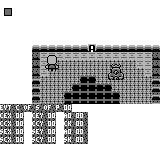
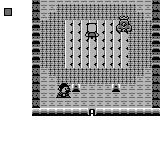
Original archive paths: world_art_previews/desert/great_temple/floor3/flooded_route.png and drained_route.png. Images are unmodified first-party project artifacts.
A single persistent state—the sluice's position—allows the same authored room to present distinct movement rules. In FLOODED state, some lower ground is inaccessible because it lies under deep water, while shallow shelves and upper currents remain navigable. In DRAINED state, previously submerged stone opens, but certain higher routes close. To complete the main circuit, the player is expected to learn when each environment is useful.
Why tiles and collision must agree
This design is especially demanding on Game Boy hardware. When a room changes visually, a movement probe must agree with the new picture. A tile that looks like solid stone but still blocks movement would break the illusion, and a tile that looks like deep water but lets the player walk through would break the puzzle.
The Floor 3 source design specifies a compact per-room patch record: each patch targets a tile position and persistence condition, replacing both the rendered tile and packed collision, terrain and modifier values. Both scrolling renderers and the collision probe route through the same patch resolution. In other words, changing the water should alter not just the background, but what movement actually means in that space.
The enemies belong to the place
The documented ecology is intentionally tied to those changing routes. Drowned sentinels wait near the vestibule's shallow shelf. Current-riding scarabs make the Western Cistern's flowing lanes part of the danger. The Eastern Pump Hall includes cursed water beneath its ambush positions, and the Sunken Archive's court spirits respond to intrusion. At the heart of it sits the Drowned Regent, a guardian whose battlefield depends on the water state.
These are authored encounter roles and historical design specifications. We are not claiming every one of them has passed today's complete ordinary-play acceptance.
A relic that follows the player home
The intended reward is the Tideheart, claimed from the Abyssal Reliquary. Its identity continues outside the Temple: equipped in the relic slot during rain, it can enable a generated attunement response. The weather contract describes a lightning-cast bonus, periodic mana pulse and a calmer water-current push effect. The story of the relic therefore connects the dungeon's physical water machinery to the wider world's weather.
That connection is also a technical test. A unique reward must not duplicate when a player returns to the room; weather must be reconstructed correctly after Continue; and the game needs to remember puzzle progression without copying a live temporary room buffer into the save.
What was demonstrated, and what is still owed?
The Drowned Court plan was completed and historically sealed in August 2026, with scripted emulator batteries and an earlier clean-SRAM three-floor journey report. The current generated indoor manifest still records the three Temple floors as 7, 8 and 9 rooms. Both are real sources of evidence, but they refer to different kinds of proof.
Current verification label: SOURCE-IMPLEMENTED and HISTORICAL TESTED. The full November 2026 source-matched BASELINE-PS1 route—including safe private SRAM, verified loaded ROM identity, ordinary progression, save and Continue—is still UNVERIFIED. This distinction prevents an earlier success from being mistakenly presented as a newly tested build.
The adventure ahead
The goal is to let a player discover all this without knowing anything about persistence bits, code banks or tile patches. When the environment visibly responds to an action, the device and its code should disappear from the player's mind. They should just know that they moved the water—and now the Temple has changed.
Source notes: FlyGame Great Temple Floor 3 design and August 7 completion seal; generated indoor runtime manifest reviewed November 15, 2026; Tideheart Weather Runtime Contract (August 11, 2026).
Continue reading: The Great Temple · Tideheart and Weather · Engineering Bench · Magazine Archive